BlastHawk VIBRA — Pro-Spectrum Edition Vibrograph
The four-channel vibrograph built in India
BlastHawk VIBRA — Pro-Spectrum Edition is a four-channel blast vibration monitor: the vibrograph, or seismograph, a mine uses to measure and prove what its blasts actually do. It records triaxial ground vibration and air overpressure at the same time, stamps every event with GPS-disciplined time, and turns the record into a DGMS-ready report.
A seismograph is only useful if the number it reports is defensible. That is the design brief here: four true simultaneous 24-bit channels at up to 16,384 samples per second (Pro-Spectrum), a geophone pod that is genuinely on the ground, a microphone that reads the air rather than the box it lives in, and a timing chain that cannot drift.
“No other blast vibration monitor of this class is designed, engineered and manufactured end-to-end in India.”
R&D manufactured by AMW Hardware and Software Labs. BlastHawk VIBRA is designed, engineered, developed and manufactured end-to-end in India by AMW Hardware and Software Labs — the in-house hardware, firmware, embedded-software and cloud R&D group of AMW Mining. The instrument, its IoT platform and its reporting software are all built in-house, from the circuit board to the cloud.
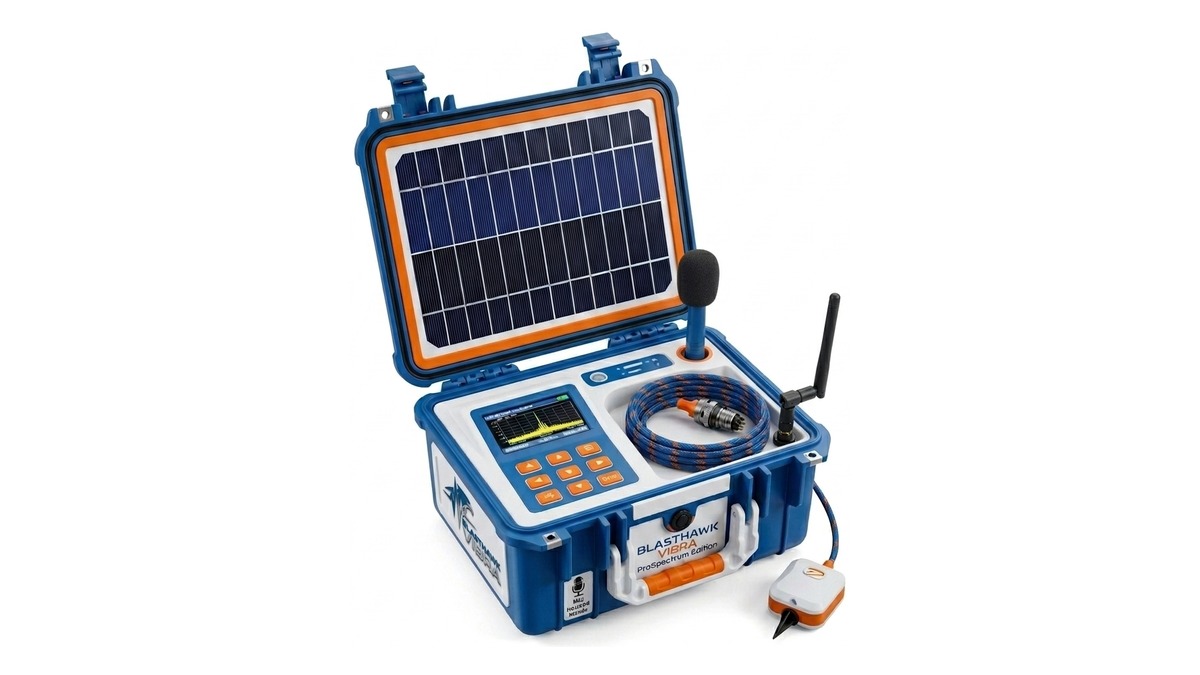
BlastHawk VIBRA — Pro-Spectrum Edition
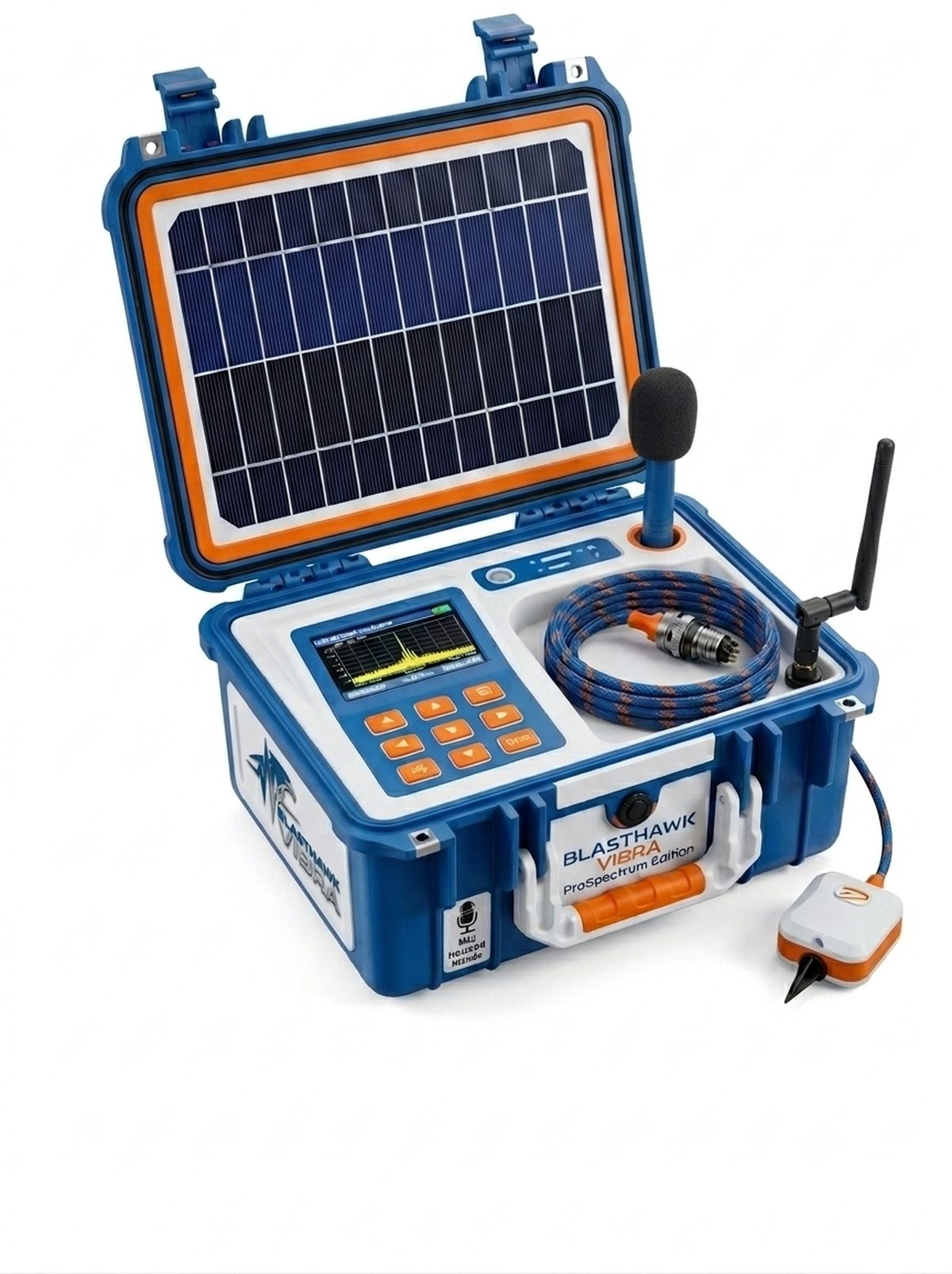
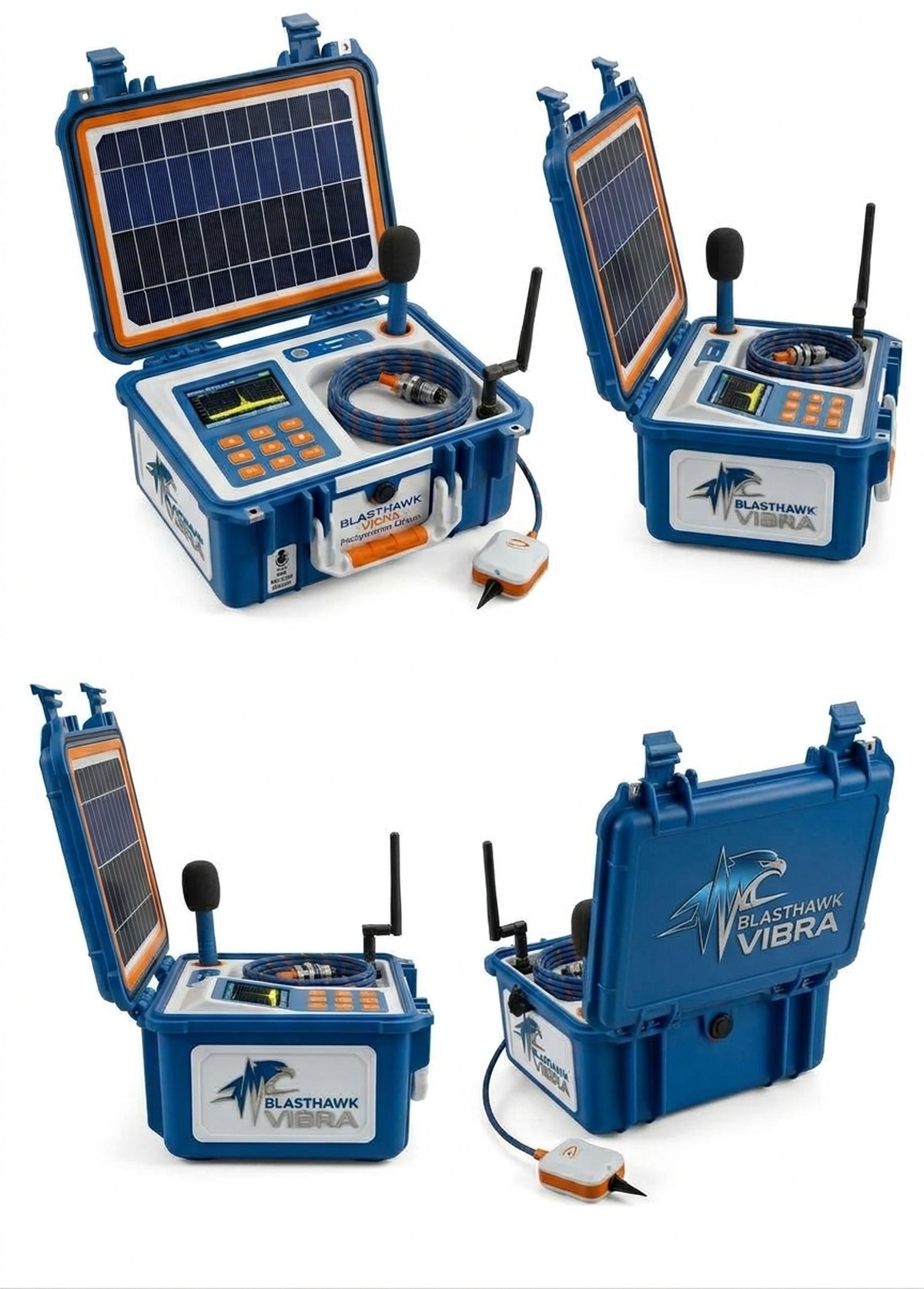
The instrument as supplied: the sealed four-channel logger and its separate triaxial geophone pod, shown here in single and four-angle views.
What the four channels measure
Ground vibration on three axes and air overpressure on a fourth, all live at once — the measurement basis that DGMS and ISEE methods assume.
Triaxial ground vibration
Three orthogonal geophone elements — vertical, longitudinal and transverse — in a 4.5 Hz pod spiked into the ground. The axes combine into the resultant peak particle velocity that a vibration limit is written against.
Air overpressure
A half-inch IEPE microphone on a fourth channel records the airborne pressure pulse. It is ISO-mounted inside the case and reads through an acoustic port, so the instrument never hears its own enclosure.
24-bit, no multiplexing
Every channel has its own 24-bit front end at up to 16,384 samples per second (Pro-Spectrum). Nothing is shared or switched, so a peak on one channel cannot slip through while another is being sampled.
GPS-disciplined timing
Absolute, drift-free time on every event, backed by an on-board real-time clock. Records from several instruments on one site line up with each other without manual correction.
BlastHawk VIBRA — Pro-Spectrum Edition specification
Every figure below is a measured instrument specification, not a marketing range. The same values are published in the product brochure (Rev A) and are confirmed on the calibration certificate supplied with each unit.
| Channels | 4 simultaneous — 3 triaxial ground vibration (vertical, longitudinal, transverse) + 1 air overpressure |
|---|---|
| Seismic sensor | 4.5 Hz triaxial geophone pod, spiked to the ground |
| Air overpressure | ½" IEPE microphone, 92–148 dB(L), ISO-mounted behind an acoustic port |
| Velocity range | 0–254 mm/s peak particle velocity (PPV) |
| Resolution | < 0.005 mm/s |
| Accuracy | ±5% or ±0.5 mm/s, whichever is greater, 4–125 Hz |
| Frequency response | Flat, 2–250 Hz |
| Sample rate | 1,024 / 2,048 / 4,096 samples per second per channel; 16,384 S/s (Pro-Spectrum) |
| Converter | 24-bit simultaneous sigma-delta front end |
| Record modes | Waveform, histogram and combined |
| Seismic trigger | 0.19–254 mm/s, selectable |
| Acoustic trigger | 92–148 dB(L) |
| Pre-trigger | 0.25 s — the trace starts before the trigger, so the first arrival is never clipped |
| Dead time | Zero between consecutive events |
| Event storage | 500 events or more on the on-board microSD card (FAT32) |
| Timing | GPS-disciplined, with a battery-backed real-time clock |
| Display and keypad | TFT / 8 × 20 character LCD; 8-key keypad |
| Connectivity | Built-in 2.4 GHz Wi-Fi access point (TCP/IP) — no SIM, no data contract, no subscription |
| Power | 12 V internal battery; solar input with integrated MPPT |
| Autonomy | 7+ days on battery; up to 30 days with solar |
| Geophone cable | 25 m, screened |
| Geophone mounting | 3 × 100 mm ground spikes |
| Enclosure | Sealed to IP67 (IEC 60529) |
| Operating temperature | −10 °C to +50 °C |
| Dimensions | Instrument case 380 × 300 × 200 mm; geophone pod 110 × 110 × 80 mm |
| Weight | Under 2.0 kg |
| Calibration | Supplied with a calibration certificate |
| Reporting | BlastHawk Cloud dashboard and PC software; DGMS-ready report export |
| Origin | Designed, engineered and manufactured in India by AMW Hardware and Software Labs |
Specifications are typical for the Pro-Spectrum Edition. Ask for the current calibration certificate for the exact unit quoted.
Built for a working mine, not a laboratory
The features that decide whether a vibration record survives an inspection are the ones about field conditions: what happens before the trigger, and what happens over a month with no mains power.
0.25 s pre-trigger
The trace begins before the trigger point, so the first arrival and the true peak are captured rather than clipped off the front of the record.
Zero dead time
Consecutive events are stored back to back with no gap between records, so a multi-delay blast or a rapid sequence is not missed between captures.
500+ events on board
Events are written to the on-board microSD card, so no laptop or network is needed in the field. Download the round when it suits you.
Sealed to IP67
Dust, monsoon rain and washdown are the normal working conditions, not an exception. The instrument case is sealed to IP67.
Solar-ready autonomy
At least seven days on internal power, extended to around thirty with a solar panel — enough for a monthly monitoring round with no mains supply.
Its own Wi-Fi, no SIM
The instrument raises a 2.4 GHz Wi-Fi soft access point. A phone or laptop connects straight to it: no router, no internet, no SIM and no data contract.
LCD, keypad, buzzer, LED
Arm the instrument and read its state at the box without opening a phone — a keypad and LCD for control, a buzzer and status LED to see the state from across the bench.
DGMS-ready reporting
Each event exports with peak particle velocity, dominant frequency, air overpressure, the waveform and the site metadata an inspection asks for.
BlastHawk Cloud, PC software and the reports a regulator asks for
The instrument is half of it. The other half is what the record looks like when a DGMS inspector, a client or a village committee asks for it.
BlastHawk Cloud dashboard
Events upload to a per-site dashboard that tracks peak particle velocity against the limit that applies to that structure and shows the trend across the monitoring period, not just the last blast.
PC software
Full waveform viewing, side-by-side event comparison and report export on Windows, for the detailed analysis a scaling-law study or a complaint investigation needs.
DGMS-ready records
Exportable per-event and per-period reports carrying PPV, frequency, air overpressure, the waveform and site metadata, in the form an inspection or an audit expects.
Your data stays yours
With no SIM and no subscription there is no third-party service in the middle of your monitoring record. The events are held by the mine, on the mine's own instrument.
An edge-to-cloud IoT platform, built in-house by AMW Hardware and Software Labs
BlastHawk VIBRA is not just an instrument. It ships with a dedicated IoT platform — acquisition, analysis, compliance, alarms and reporting — developed in-house by AMW Hardware and Software Labs, so the instrument, the edge software and the cloud service are one product from one team.
Edge-to-cloud architecture
The VIBRA edge node (rugged four-channel logger with 24-bit ADC, GPS-disciplined timing, Wi-Fi soft-AP and offline event spool) feeds a site gateway, which relays spooled events to BlastHawk Cloud — on-premises or in a private cloud. An optional MQTT gateway uplink is available.
Live dashboard
KPIs, station health and auto-refresh over a live WebSocket feed, so the bench sees the current state of every station rather than yesterday's download.
Event archive & waveforms
A searchable archive with four-channel waveforms, drag-to-zoom and PPV markers, so an event can be inspected and evidenced without leaving the platform.
Analysis engine
PPV and peak vector sum; dominant frequency by zero-crossing and FFT; scaled distance to USBM and ISO methods; and a site-law fit (K, b) from the site's own monitored events.
Compliance engine
Every event is evaluated against DGMS, IS 6922, DIN 4150-3, USBM RI 8507, AS 2187.2 and ISO 4866, returning PASS/FAIL with the margin to the governing limit.
Alarm engine
A rule builder with severity levels, cool-down, webhook and e-mail alerts, an acknowledgement workflow and a full audit trail, so an exceedance is raised and closed with a record.
Reports & integration
One-click PDF reports, a 30-endpoint REST API, a zero-dependency Python SDK, a live WebSocket feed and an installable offline-first PWA for the bench.
Data governance & security
On-premises or private-cloud deployment with no external services required, role-based access control and a full audit trail — aligned to India's DPDP Act 2023 and, for projects abroad, GDPR data-minimisation.
Best in class in India — and built for the Gulf and Africa
Same instrument, three very different sets of field conditions. The design answers each of them without a different product.
India
- Designed, engineered and manufactured in India — no import lead time, customs delay or foreign-currency cycle.
- Reporting aligned to DGMS vibration requirements and ISEE-grade measurement practice.
- Calibration, spares, commissioning and operator training available in-country.
- Priced and invoiced in rupees, with an Indian entity to contract and service.
Gulf & GCC
- Sealed IP67 construction for dust and heat, with a case designed for a desert quarry rather than a bench.
- No SIM and no data contract — the right answer where coverage is patchy and roaming data is expensive.
- Solar autonomy for remote quarries and crusher sites away from mains power.
- Supported for export by DGFT IEC registration and UNGM supplier status.
Africa
- Works entirely offline: its own Wi-Fi network, on-board event storage, no dependence on cellular coverage.
- Month-scale deployments on solar, so a monitoring programme runs without a return visit.
- No subscription means no recurring foreign-currency cost against the project.
- Records stay on site, which matters where the data is part of a land or community agreement.
What you get that a mixed-sourcing instrument does not
Not a feature list — the handful of things that change the cost and the defensibility of a vibration monitoring programme.
- Made in India, end to end. Designed, engineered, developed and manufactured in India by AMW Hardware and Software Labs — no other blast vibration monitor of this class is built end-to-end in India, so the supply chain, the pricing and the service are all domestic.
- In-house IoT platform. The instrument, the edge software and the BlastHawk Cloud service are one product from one team — acquisition, analysis, compliance, alarms and reporting, developed in-house by AMW Hardware and Software Labs.
- Four true simultaneous channels at 24-bit. Three axes plus air overpressure captured at once, with no multiplexing between them.
- No SIM, no data contract, no subscription. You buy the instrument and you own the monitoring record; there is no recurring service fee and no third party holding the data.
- GPS-disciplined timing with a battery-backed clock. Records from a multi-instrument array align without post-processing.
- Solar-ready thirty-day autonomy. A single round covers a month at a site with no mains power.
- Calibration certificate and retained history. Traceable to national standards and produced on demand for an audit or a DGMS inspection.
- Buy or hire. Hire suits a single project or a seasonal campaign; purchase makes sense once the instrument is in regular use.
- Supported in India, the Gulf and Africa. Commissioning, training, calibration and spares from AMW Mining, with DGFT IEC and UNGM registration behind the export.
Get the BlastHawk VIBRA on your site
Tell us the site, the receptors and the vibration limit you have to hold. We will quote the instrument — purchase or hire — and, if you want it, run the baseline survey and the reporting that goes with it.
Vibrograph · Seismograph · Blast vibration & air-overpressure monitoring · Made in India by AMW Hardware and Software Labs
BlastHawk VIBRA — Questions & Answers
What the instrument measures, what it needs to run, where it works, and how it is calibrated and supported.
A seismograph — called a vibrograph in Indian mining practice — records the ground vibration and air overpressure produced by a blast and stores the waveform so the result can be checked against a limit. The BlastHawk VIBRA records both on four simultaneous channels and produces DGMS-ready reports. Ground vibration is measured as peak particle velocity (PPV) on three orthogonal axes, and air overpressure on a fourth channel.
Four, all sampled at the same time: three for triaxial ground vibration (vertical, longitudinal and transverse) and one for air overpressure. There is no channel multiplexing, so a peak on one channel cannot be missed while another channel is being read.
Peak particle velocity from 0 to 254 mm/s with a resolution of 0.005 mm/s or better. The response is flat from 2 to 250 Hz, accuracy is ±5% or ±0.5 mm/s between 4 and 125 Hz, and each channel samples at 1,024, 2,048 or 4,096 samples per second at 24-bit, with 16,384 S/s on the Pro-Spectrum Edition.
No. It creates its own 2.4 GHz Wi-Fi network that a phone, tablet or laptop connects to directly. There is no SIM, no data contract and no subscription, so the instrument and its data stay with the mine.
Yes. BlastHawk VIBRA ships with a dedicated edge-to-cloud IoT platform — acquisition, analysis, compliance, alarms and reporting — developed in-house by AMW Hardware and Software Labs. It includes a live dashboard, a searchable event archive with four-channel waveforms, an analysis engine (PPV, peak vector sum, dominant frequency, scaled distance and site-law fit), a compliance engine covering DGMS, IS 6922, DIN 4150-3, USBM RI 8507, AS 2187.2 and ISO 4866, an alarm engine with an acknowledgement workflow, one-click PDF reports, a 30-endpoint REST API and a zero-dependency Python SDK. It runs on-premises or in a private cloud with no external services required.
Yes — it is designed, engineered, developed and manufactured in India by AMW Hardware and Software Labs, the in-house R&D group of AMW Mining. No other blast vibration monitor of this class is designed, engineered and manufactured end-to-end in India.
That is what it is built for. The case is sealed to IP67, timing is GPS-disciplined so no network is needed, events are stored on the instrument's own microSD card, and a solar panel extends endurance from at least seven days to about thirty.
At least seven days on internal power as standard, and up to about thirty days when a solar panel is connected. That suits a monthly monitoring round at a site with no mains supply.
Every unit is supplied with a calibration certificate traceable to national standards, and the calibration history is retained so it can be produced for a DGMS inspection. The BlastHawk VIBRA is available to buy or on hire, in India and for export.
Yes. AMW Mining holds DGFT IEC import-export registration and United Nations Global Marketplace supplier status, and supports the instrument in the Gulf and Africa with commissioning, operator training, calibration and spares.